
SpaceX's $1.7 Trillion Moat Isn't Rockets, It's 'People'
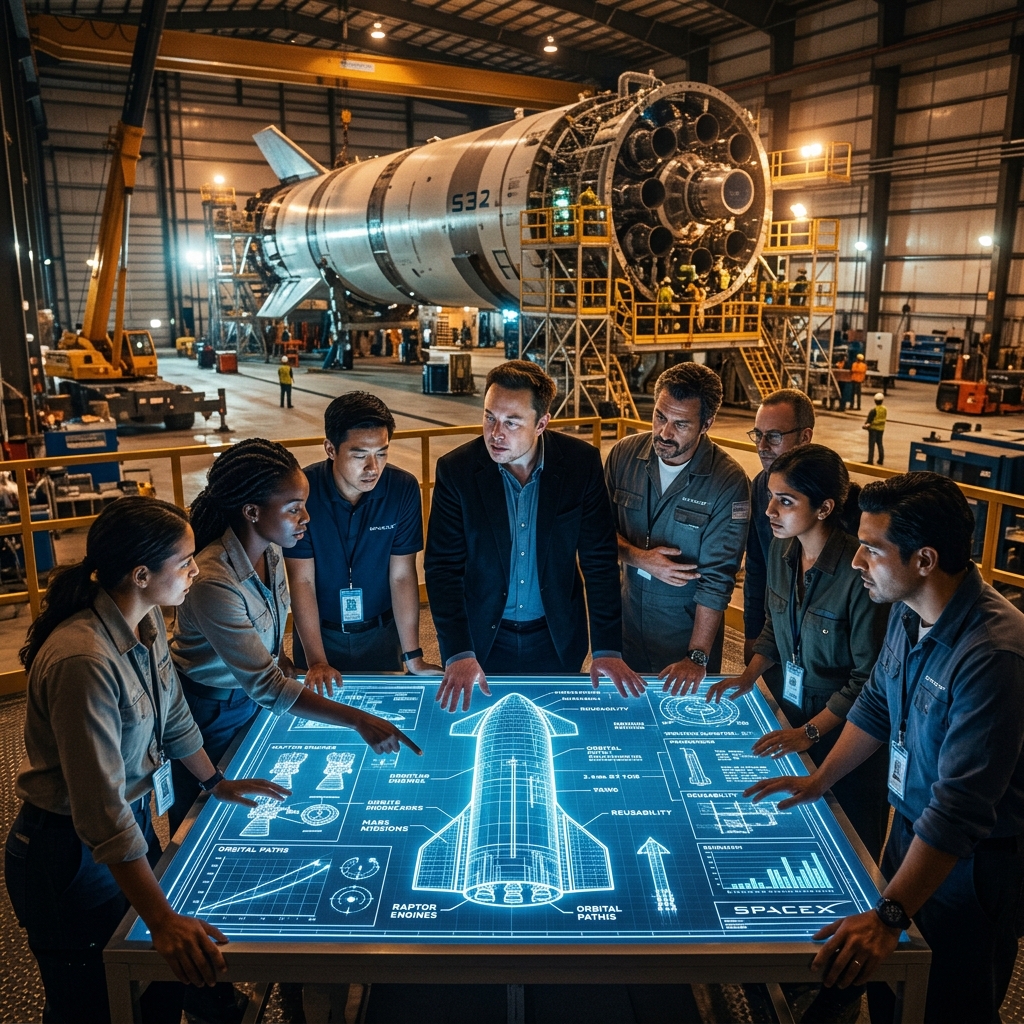
"There are a lot of problems in the world. We need to solve those problems. But we also need things that make you excited to wake up in the morning, things that make you look forward to the future. That is the future SpaceX can bring to you." — Elon Musk, SpaceX June 12, 2026 IPO Speech
An Old Romance for Space, and Reality
My dream in high school was to become an aerospace engineer. What turned my vague longing into a concrete career path was the story of a space probe. It was the 1997 Mars Pathfinder mission. Shortly after landing, the probe's system suffered from continuous reboots—a fatal flaw caused by a software bug known as 'Priority Inversion' in its Real-Time Operating System (RTOS). Seeing a multi-hundred-million-dollar piece of cutting-edge hardware nearly become a pile of scrap metal tens of millions of kilometers away in space just because of a few lines of code, I was fascinated by the 'power of software' to perfectly control and breathe life into massive hardware. Ultimately, this led me to major in computer science.
Although I never became an engineer writing software that boards real spacecraft, my romance for space carried over into investing. In 2011, driven solely by my 'romantic vision of space,' I bought shares in Korea Aerospace Industries (KAI) and held onto them for an incredibly long 11 years until 2022. To me, the space industry has always been a thrilling, uncharted territory that cannot be quantified solely by the yield numbers on a balance sheet.
However, the ones who proved this grand romance as a reality-based business—and as an overwhelming victory of capitalism—were someone else.
The Man Who Translated Romance into Physics and Capitalism
In 2001, armed with a fortune from the sale of PayPal, Elon Musk conceptualized a dream-like project called 'Mars Oasis'. The plan was to land a miniature greenhouse containing nutrient gel and seeds on the surface of Mars, transmitting a photograph back to Earth of green life growing against the backdrop of the red planet. His true goal wasn't to build a colony immediately. It was to reignite the public's passion for space, which had grown cold since the Apollo moon landings, and ultimately to profoundly inspire the U.S. government and NASA to increase their space exploration budgets.
But sending this beautiful little greenhouse box was far too expensive due to the 'shipping fee' (rocket launch costs). Seeking cheaper rockets, he flew to Russia to purchase decommissioned Intercontinental Ballistic Missiles (ICBMs). The result was disastrous. Russian officials demanded an absurd price and blatantly mocked the young nouveau riche. Infuriated, Musk calculated the raw material cost of a rocket himself on the flight back.
"Wait, the raw materials are only 2% of the total cost of a rocket? It’d be better if I just started a rocket company myself."
And so, in 2002, the seemingly reckless space exploration company 'SpaceX' was born from scratch. We often attribute SpaceX's success to Elon Musk's individual genius. However, the real reason this grand narrative—which initially felt like a massive scam—gained physical substance as a $1.7 trillion corporate giant lies in the 'collective intelligence of genius engineers' who chiseled Musk’s pipe dream into reality, one screw and one line of algorithm at a time.
From an investment perspective, the true moat of SpaceX that we must analyze is not the titanium alloy of the Falcon rocket, but the overwhelming 'Talent Density' and 'DNA of problem-solving' they have forged.
The Founding Members Who Tore Down Impossibility: Creating Something from Nothing on the Edge of Bankruptcy
1. Employee #1 Tom Mueller: "Shattering Bureaucracy to Build Rockets in a Garage"
In traditional aerospace companies like Boeing or Lockheed Martin, it was common knowledge that developing a single rocket engine took at least 10 years and wasted hundreds of millions of dollars in taxpayer money. This was due to a structural pathology where responsibility was diffused and costs ballooned exponentially through endless layers of subcontractors.
Having decided to build his own rockets, Musk started scouting amateur rocket clubs in Los Angeles (the Reaction Research Society). There, he discovered a hidden gem: a mild-mannered engineer who worked at a large aerospace firm (TRW) by day, but spent his weekends tinkering and test-firing liquid-fueled rocket engines in his garage and a shabby warehouse as a hobby. His name was Tom Mueller.
Astonished by the sophisticated 80-pound thrust rocket engine built in a personal warehouse, Musk asked bluntly, "Can you build something bigger than this?" With Mueller's confident "Yes," the two met on Super Bowl Sunday, sketched a rocket design on a napkin, and Mueller became SpaceX's very first employee.
💡 Investment Insight: The Magic of Extreme Vertical Integration The greatest legacy Mueller implanted into SpaceX is not just an engine schematic. He obliterated the traditional industry's 'subcontracting practices' and aggressively adopted early 3D printing technology to achieve 'extreme vertical integration', manufacturing over 85% of components in-house. The 'Merlin engine' he created—prototyped rapidly and destructively just as he played in his garage—is the core economic moat that allows SpaceX to maintain uncatchable profit margins and launch costs today.
2. Employee #4 Hans Koenigsmann: "The Alchemist Who Turns Explosions into Reliability"
SpaceX's early days were anything but romantic. In the late 2000s, their first rocket, the Falcon 1, exploded in mid-air three consecutive times. The company's funds were completely depleted, and even Elon Musk considered bankruptcy a foregone conclusion. The space industry is ruthless. If just one sensor or one bolt out of hundreds of thousands is misaligned, tens of millions of dollars turn to ash.
Amidst this despair, Hans Koenigsmann, who was in charge of avionics and flight reliability, didn't bang his desk in frustration. Instead, he completely overhauled the company's software and hardware testing processes.
💡 Investment Insight: Antifragile—Converting Failure into Capital The philosophy Hans forcibly institutionalized within the company was "Test as you fly." He built simulation environments on the ground that perfectly replicated the conditions of space, forcing the software and hardware through tens of thousands of extreme tests. He redefined a rocket's 'explosion (failure)' not as a disaster to be feared, but as the most expensive 'data collection process' to perfectly refine the system. He carved true Antifragility (the property of growing stronger from shocks, as coined by Nassim Taleb) into the organization's DNA. The miraculous success of the 4th launch was not luck, but the result of this ruthless reliability verification system built by Hans.
The Generation of Expansion and Monopoly: Making Mathematical Miracles an Everyday Occurrence
If the founding members created 0 to 1 by reaching orbit, the geniuses who joined during the company's explosive scale-up phase evolved SpaceX into a 'Global Space Monopoly Platform'.
3. Principal Landing Engineer Lars Blackmore: "Mocking the Limits of Physics with Mathematics"
The reason space launches were so expensive was simple: rockets (costing tens of millions of dollars) were thrown away into the ocean after a single use. SpaceX devised an insane plan to send a rocket to the edge of space, then land it backwards to reuse it.
Accurately landing a 15-story building falling at thousands of kilometers per hour onto a narrow drone ship in the middle of a turbulent ocean... Many aerospace academics mocked this plan, calling it "a mathematically impossible mission unless a miracle occurs."
But Lars Blackmore, a genius MIT-educated control mathematician who came to SpaceX after researching Mars landing algorithms at NASA’s Jet Propulsion Laboratory (JPL), was different.
💡 Investment Insight: Algorithms that Create Economics He developed an ultra-precise landing algorithm based on Convex Optimization, showcasing the absolute pinnacle of Guidance, Navigation, and Control (GNC). As a result, SpaceX staged the miracle of perfectly recovering an orbital-class rocket (Falcon 9) for the first time in the world. They broke through the limits of hardware using hyper-advanced software mathematics. From an investor's perspective, rocket reusability is a 'game changer' that entirely rewrote the economics of the space industry. With launch costs plummeting to 1/10th of previous levels, SpaceX has virtually secured a monopolistic position in the global launch vehicle market.
4. VP of Vehicle Engineering Mark Juncosa: "The Fixer Who Drags Musk’s Imagination into Reality"
Joining in 2005, Mark Juncosa is the 'ultimate Fixer' whom Elon Musk trusts and relies on the most. As SpaceX grew in size, the projects it faced were on a completely different scale. Developing 'Starlink' (blanketing low Earth orbit with thousands of satellites) and 'Starship' (the largest rocket in human history) was a battle of massive 'manufacturing and logistics systems' beyond mere ideas.
💡 Investment Insight: The Capability to Scale-Up Imagination When Starlink satellite production was sluggish, Musk fired the existing executives and brought in Juncosa. Looking at the entire structure of the rocket and system through the lens of architectural engineering rather than focusing on a single component, he completely established a system to mass-produce satellites like items coming off an assembly line in a remarkably short time. He is currently at Starbase in Texas, eating and sleeping alongside Musk while spearheading the development of Starship. Any grand vision is just a scam without an excellent COO or project manager. Juncosa's presence proves that SpaceX possesses the explosive capability to literally drag Elon Musk's seemingly delusional deadlines into 'executable timelines'.
The Long-Awaited SpaceX (SPCX) IPO: Is a $1.7 Trillion Valuation Too Expensive?
On June 12, 2026, Musk's romance for space finally reached a massive milestone: listing on the Nasdaq (Ticker: SPCX). Starting at an IPO price of $135 and surging to $150 on the first day of trading, the company achieved a staggering, unprecedented corporate valuation of approximately $1.7 trillion, shocking capital markets worldwide.
This immense valuation led traditional 'number-crunchers' on Wall Street to raise bubble concerns, calling it wildly overvalued. Looking at the financial data from 2025 released at the time of the IPO, their arguments seem somewhat plausible.
| Business Segment | 2025 Revenue | 2025 Operating Income (Loss) |
|---|---|---|
| Consolidated (Total) | $18.67 Billion | ($4.9 Billion Net Loss) |
| Telecom (Starlink) | $11.4 Billion | $4.4 Billion |
| Space (Launch) | $4.1 Billion | ($650 Million) |
| AI (xAI/X etc.) | $3.2 Billion | (Massive R&D Loss) |
Looking solely at the balance sheet, the Space (Launch) division looks like a 'money pit,' generating only $4.1 billion in revenue alongside a $650 million loss. This is exactly why traditional analysts pointed to the fundamental limits of the space launch industry and skeptically evaluated SpaceX's stock price.
However, this is nothing more than a one-dimensional analysis that entirely fails to understand the accounting illusion of 'Intercompany Eliminations'.
💡 Investment Insight: The 'Magic of Internal Transactions' Hidden in the Financials
Throughout 2025, SpaceX launched the Falcon 9 rocket a staggering 165 times. The surprising fact is that nearly 75% of these launches were not for external clients, but 'internal launches to deploy their own Starlink satellites.'
Under accounting standards, the fees the Launch division 'charges' the Starlink division for launching rockets are treated as 'internal transactions' and are eliminated from total revenue. If we assume the Launch division charged the Starlink division the standard external rate per launch (approx. $67 million), over $8.2 billion in 'vanished' launch revenue would be added.
Ultimately, the operating loss of the Space Launch division is not a true deficit. It is merely the 'sacrifice of hidden margins'—radically lowering launch costs to generate the overwhelming surplus ($4.4 billion) of the Telecom division (Starlink). Because they possess their own uniquely cheap rocket ecosystem, Starlink was able to create an unprecedented, massive Cash Cow.
From this perspective, Starlink and Starship are central variables in a SpaceX valuation. Their outcomes depend heavily on commercialization speed, capital requirements, and regulation, so $1.7 trillion should be treated as a scenario built on assumptions rather than a settled value.
📡 Starlink: An Opportunity in 6G and Non-Terrestrial Networks
Starlink is expanding beyond remote internet access into non-terrestrial networks (NTN) and direct-to-cell service. Satellites may play a larger role in 6G, but standards adoption and market share will depend on carrier partnerships, spectrum regulation, and competing networks.
Elon Musk has estimated the Total Addressable Market (TAM) for Starlink, including the 'Direct-to-Cell' market, at approximately $740 billion. Even conservative Wall Street analysts assess that the B2B (aviation, maritime, defense) and cloud infrastructure (integration with Azure, Google Cloud, etc.) markets alone represent a solid annual demand of over $130 billion. Starlink's subscription revenue gives SpaceX a recurring-revenue stream distinct from one-off launch services. The comparison with software subscriptions is useful only up to a point: satellite replacement, ground stations, terminals, and spectrum make this a capital-intensive telecom business, and a monopoly is not assured.
🚀 Starship: The Macro-economic Disruptor Tearing Transport Costs Down to 1/50th
So, what is the future value of 'Starship', the true core of the $1.7 trillion valuation and the game changer that will shake the macro-economy? Currently, the cost to send 1kg of cargo into space via the Falcon 9 rocket is around $3,000. But when Starship—capable of carrying 100 to 150 tons of cargo and being 100% reusable—is fully commercialized, this cost will plummet to $50~$100 per kg (roughly 1/30 to 1/50 of current costs). When space transport costs are destroyed so radically, new multi-trillion-dollar markets will open up:
- Point-to-Point Transport: Ultra-high-speed suborbital flights traversing to the other side of the globe in under an hour become possible. This could completely replace the ultra-long-haul Private Aviation market.
- Asteroid Mining and ISRU (In-Situ Resource Utilization): A space mineral ecosystem opens up, mining water and oxygen directly in space to produce rocket fuel and extracting rare resources.
- Orbital AI Data Centers: The biggest headache for AI data centers on Earth right now is massive electricity consumption and heat generation. By placing data centers in orbit via Starship, they can utilize infinite solar energy pouring in 24 hours a day without atmospheric interference as power, and use the extreme environment of space (-270 degrees Celsius) for Radiative cooling to dissipate massive heat for free.
- Hyper-massive Space Infrastructure Revolution: In addition to the space data centers mentioned above, derivative space industries like space-based solar power and zero-gravity pharmaceutical factories—which were unimaginable in the past due to shipping (launch) costs—will expand explosively.
SpaceX is the sole 'monopolistic transport gateway' heading toward all this space economy infrastructure. In other words, the $1.7 trillion corporate valuation is not just for a rocket company; it is the price tag attached to the 'Apple and Amazon of Space' that will conquer humanity's next internet infrastructure and entirely new space territories.
The Shadow of a Dazzling Dream: The Cold Critiques of Wall Street, Engineers, and Telcos
Yet, even in the face of this grand romance and overwhelming numerical victory, experts from various fields do not cease their sharp critiques and checks on SpaceX's rosy future. Even in this seemingly perfect empire, there are clear Achilles' heels threatening its valuation.
1. Wall Street's Critique: "Excessive Valuation and Key-man Risk"
Traditional financial analysts point out that the $1.7 trillion figure is a Bubble, pulling all its value from 'an unrealized future' (Starship commercialization, space data centers, etc.). Furthermore, SpaceX is a black hole requiring endless Capital Expenditures (CapEx). Building the Starlink V2 satellite network and mass-producing Starship burns through billions of dollars annually, pushing the turn to positive Free Cash Flow (FCF) far into the distance. Moreover, its most fatal flaw is 'Key-man Risk'. Elon Musk's unique volatility, excessive political remarks, and his divided focus across Tesla, X (Twitter), and xAI are evaluated as a ticking time bomb that could severely shake the company's governance at any moment.
2. Traditional Aerospace Engineers' Critique: "Physical Limits and the Kessler Syndrome"
The 'Test as you fly' culture that drove SpaceX to success worked for unmanned cargo rockets, but engineers point out that it is entirely unacceptable for interplanetary migration or 'Point-to-Point' transport involving humans. They argue that Musk severely underestimates the conservative regulations of the Federal Aviation Administration (FAA) and the extreme complexity of life-support systems in fields where human lives are at stake. Additionally, the light pollution and space debris problem caused by tens of thousands of Starlink satellites is already at a disaster level. SpaceX is pointed out as the biggest potential culprit for the 'Kessler Syndrome'—a scenario where a chain reaction of satellite collisions turns low Earth orbit into a junkyard, making human space exploration itself impossible.
3. Global Telcos' Critique: "The Laws of Physics Cannot Be Ignored"
Existing telecom giants like Verizon, AT&T, and major domestic telcos dismiss the prospect that Starlink's 6G D2C (Direct-to-Cell) technology will perfectly replace terrestrial networks. Due to the limitations of frequency bandwidth and physical distance, it is physically impossible for satellite networks to handle the data traffic of hundreds of thousands of simultaneous users in dense urban areas. Ultimately, they draw a line, stating that Starlink will remain a complement for 'Niche Markets' (maritime, aviation, deserts) or disaster networks where terrestrial networks cannot reach, and that global monopoly is an illusion blocked by the massive barriers of strict frequency licensing and telecommunications sovereignty (security) regulations of various governments.
In the end, for SpaceX's $1.7 trillion valuation to be justified, they must not simply be good at launching rockets; they must simultaneously smash through three massive walls: the capital pressure of Wall Street, the control of regulatory authorities, and the fundamental limits of physics.
The Essence of Investment: What Do We Believe In to Stay the Course?
Having once idolized space while investing in KAI, I now look at SpaceX's stock ticker and reconsider the essence of investing.
Truthfully and objectively, today's SpaceX is distinctly different from the days when they carved engines in a garage under the fear of bankruptcy. Elon Musk, born in 1971, is already in his mid-50s. The hungry Musk of his 30s and 40s, who always bulldozed ahead risking his life, might not be the same Musk today, who has risen to the ranks of the world's richest and is entangled in immense political noise and massive lawsuits.
The great engineers listed above have also aged. Alongside SpaceX's growth, they have already amassed wealth they couldn't spend in a lifetime, and the fierce 'hungry spirit' and passion of staying up all night on the edge of bankruptcy might have cooled slightly. The bubble warnings from critics, regulatory barriers, and the aging of the founding members are massive risks that an investor must clearly acknowledge.
And yet, despite all this, I am willing to burn my capital on the vision of these great fools.
The flashy numbers on the balance sheet or Elon Musk's provocative tweets are merely the shell. The 'overwhelming Talent Density' of those who crushed any physical limit that stood in their way with collective intelligence has already settled into a massive system that evolves on its own, transcending individual passion.
As in Musk's speech quoted at the beginning of this article, investing is not merely the act of multiplying yield numbers in an Excel sheet. The things that make you happy to wake up in the morning, the anticipation that makes you eager to see what miraculous thing will happen in space tomorrow. That is the true reason I willingly invest in the romance of space, despite taking on all sorts of risks.
In the end, the ones who change the world are not the pessimists in front of calculators, but the great optimists (engineers) who throw their lives at space, mocking physical limits. Whenever the numbers in my account wildly fluctuate, I too will gaze at the trajectory of the Falcon rocket slicing through the night sky and joyfully join this great journey.
Do nothing and simply own the trajectory of dreams where great companies and great talents fiercely pioneer space. And hold on to the very end.
Stay the Course. 🌿