
Warren Buffett Donated Another Billion — And I Reflected on Myself
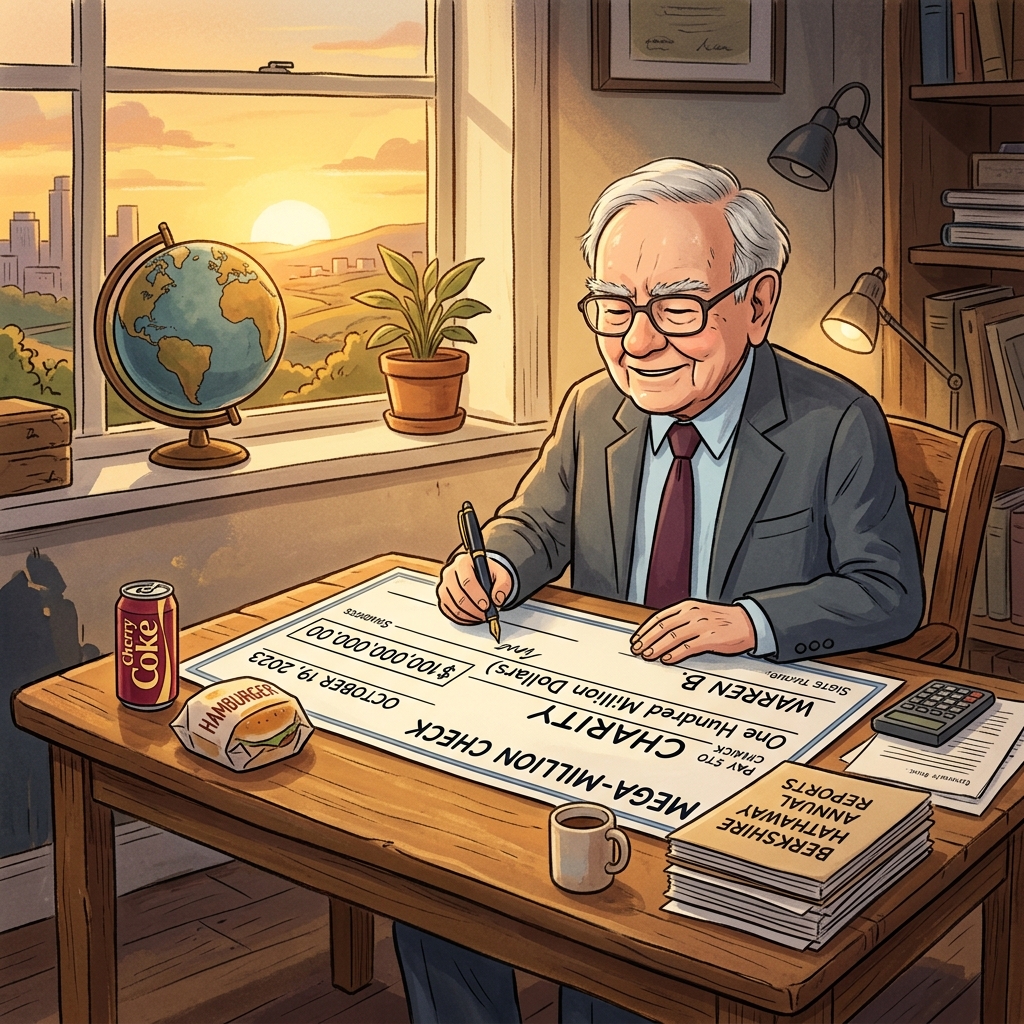
📰 Original Article: Warren Buffett Donates Another $1 Billion — WSJ
(WSJ Subscription Required · November 2024)
One night in November 2024, I opened my brokerage app and was staring at my return rate.
+3.2%. Not bad. But for some reason, I felt strange.
Then, a news alert popped up.
"Warren Buffett donates an additional $1.1 billion of Berkshire Hathaway stock"
About 1.4 trillion KRW. He just gave it away. Again.
Grandpa Buffett's Daily Life
Looking at grandpa Buffett's history of donations is quite surprising.
Since 2006, he has pledged to donate over 99% of his wealth, and he actually gives away a little bit — well, not a little bit, but billions of dollars — every year.
This time, he distributed the donation across four family foundations run by his children. He also changed his will, which previously entrusted his wealth to the Bill & Melinda Gates Foundation. Now, after he passes away, his remaining wealth will go into a charitable trust, where his three children must make decisions unanimously.
And he left this message in his shareholder letter:
"Before signing your will, have your adult children read it first. Explain to them why you made these decisions."
A 93-year-old grandfather's advice on wills. It's somewhat warm, yet somewhat realistic.
By the Way, How Did Buffett Become 'That Buffett'?
In fact, the Warren Buffett of today wasn't like that from the beginning.
Anyone studying investing has probably heard the name Benjamin Graham. Buffett took Graham's class at Columbia University and was completely captivated. After graduating, he joined Graham's company, Graham-Newman Corporation, and received direct teachings. In a way, Buffett 1.0 was a copy of Graham.
Graham's Philosophy: Cigar Butt Investing
Graham's method goes like this. You pick up a discarded cigar butt off the street. It's dirty and unappealing, but there's still one puff left in it. Since you picked it up for free, that one puff is pure profit.
Translated into investing, it means buying a company whose stock price is trading much lower than its liquidation value (book value). It's a structure where, even if the company goes bankrupt, selling off its assets leaves a profit. You aim for that one-time value recovery and sell it off.
This method actually worked quite well. Buffett made some pretty sweet returns in his youth using this strategy. However, there was a problem. A cigar butt only has one puff. After smoking it, you have to go out and find another butt. As his portfolio grew, this method began to show its limitations. And because he kept buying cheap companies, he always found himself surrounded by mediocre businesses.
Buffett himself later confessed. Berkshire Hathaway was actually a cigar butt too. He bought a textile mill because it was trading at a bargain, couldn't resell it, and ended up holding onto it for decades. He admitted this by calling it a "monumentally stupid mistake."
And Then Charlie Munger Appears
In 1959, Buffett met Charlie Munger for the first time at a dinner party. This eccentric former lawyer shot back at Buffett's words without hesitation and even refuted a few points. Buffett recalls that dinner as "one of the most important meetings of my life."
Munger's message was simple.
"It's far better to buy a wonderful company at a fair price than a fair company at a wonderful price."
This was the birth of Buffett 2.0.
Munger accurately pinpointed the limitations of Graham's numbers-only approach. If you buy a company just because it's cheap, you end up owning a cheap company. On the other hand, a wonderful company with a moat that competitors can't easily cross will earn money on its own over time, without you ever having to sell it.
The first experiment for this was See's Candies. In 1972, persuaded by Munger, Buffett bought this chocolate company for $25 million. From Graham's perspective, it was an expensive price. But over the next 50 years, See's Candies brought Berkshire over $2 billion in profits. He bought it once and waited 50 years.
After that came Coca-Cola, American Express, and later, Apple. Buffett became a completely different person.
He later said:
"Charlie brought me back to my senses."
Then, Should I Practice Value Investing?
Here, I have to be honest.
The ability to analyze a company's intrinsic value, evaluate its moat, and forecast its earnings 10 years down the line like Buffett and Munger — I don't have it.
I don't know how to deeply read financial statements, nor do I have the insight to pierce through industry structures. Munger's discerning eye that looked at See's Candies and confidently said, "This is a wonderful company," is something I probably couldn't easily follow even if I studied it for a lifetime.
So I chose a different path.
ETF Dollar-Cost Averaging.
If I can't judge the value of individual companies, I can just buy the whole market. Whether it's the S&P 500 or global stocks. With the single belief that humanity has steadily grown and will continue to do so, I set up a system to automatically buy a fixed amount every month.
This isn't Buffett's method. But interestingly enough, Buffett himself recommends this method to the average investor.
"For most investors, the best method is to consistently buy a low-cost index fund."
A man who learned from Graham, was enlightened by Munger, and spent decades analyzing stocks ultimately recommends this method to ordinary people. Perhaps I'm a model student who listens well to the teacher's words. Or maybe I'm just lazy. 🤷
So What Was I Doing?
I went back to my app.
+3.2%.
I was riding an emotional roller coaster over this number. Feeling good if it went up today, feeling uneasy if it went down. Sometimes wavering on whether investing every month is even meaningful.
But seeing the news about Buffett made me pause for a moment.
Was his goal to make money? Probably not. It seems he viewed investing as a way of living life. Not piling up money, but creating a pipeline that lets money flow out into the world.
I am someone who is still blocking the entrance of that pipeline. But someday, I want to let it flow. Even if it's small.
The Reason I Made This Site
To be honest, the day I saw this article was the catalyst for creating this site.
One Billion Dollar Donation. It sounds like a ridiculous dream. I'm an office worker, I have two daughters, and today, the system I built is automatically buying stocks again.
Buffett wasn't someone who donated a billion dollars from the start, either. He just did it his way, consistently, for a long time.
Stay the Course. Don't waver, keep going.
I've decided to just live that way, too. 🌿
This post is a fan letter to grandpa Buffett, and a pledge to myself.