
A Great Invention Comparable to the Alphabet and the Wheel: How John Bogle Created the Index Fund
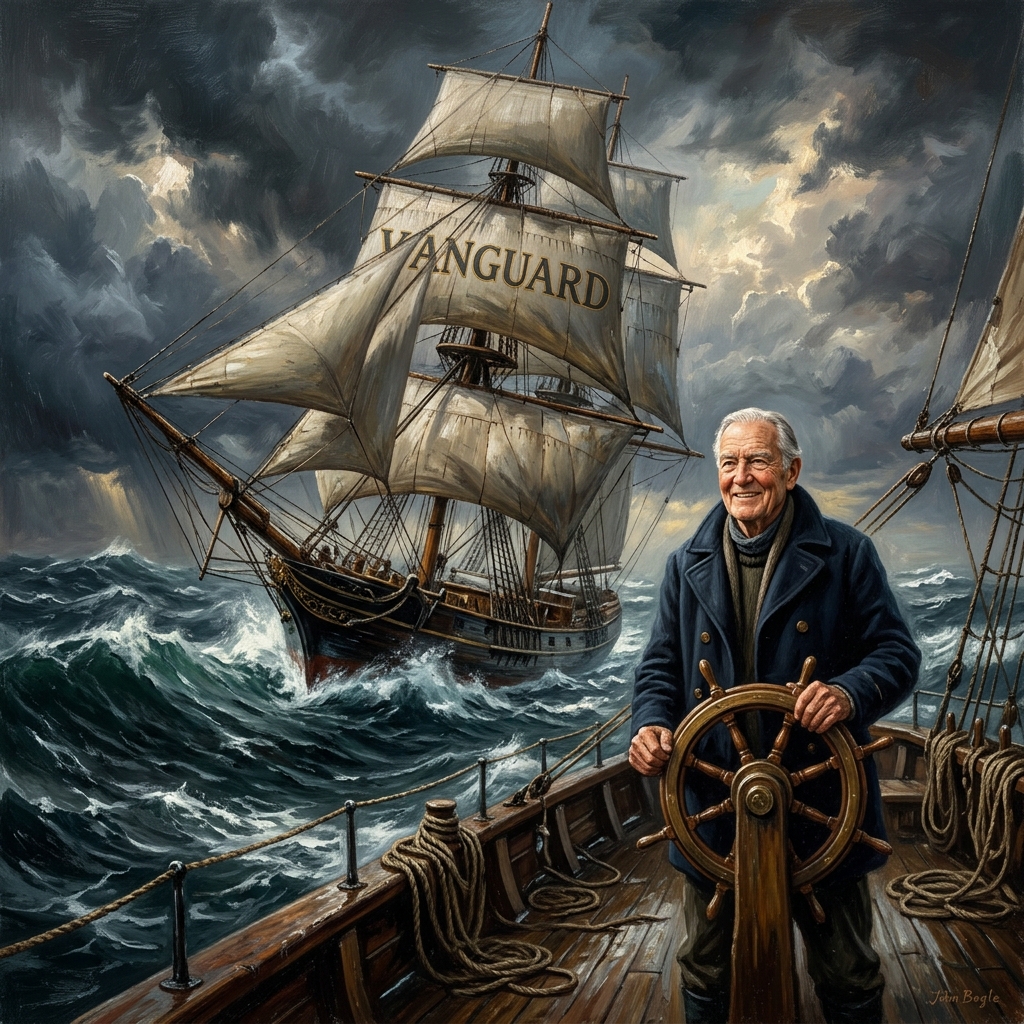
"I rank this Bogle invention along with the invention of the wheel, the alphabet, Gutenberg printing, and wine and cheese: a mutual fund that never made Bogle rich but elevated the long-term returns of the mutual-fund owners. Something new under the sun." — Paul Samuelson (Nobel Laureate in Economics)
There are two well-worn books in my study: The Little Book of Common Sense Investing and Stay the Course. Whenever the stock market wildly fluctuates, instead of staring at bleeding red charts, I open these books.
John C. Bogle. Most people fondly call him 'Jack'. The 'index fund' he created is the compass that guides my investing today, and arguably the greatest invention that saved millions of ordinary working-class investors.
How on earth did this man overturn more than 200 years of Wall Street common sense and create such a monumental invention?
A Genius College Student Strikes Wall Street's Core
The story goes back to 1951. Jack Bogle, then a senior at Princeton University, delved into the mutual fund industry for his senior thesis. And he discovered a very simple but painful truth.
"Once you deduct the high fees taken by fund managers, they ultimately cannot beat the market's average return over the long term."
This provocative insight by a 22-year-old college student would later become the very first seed of the 'index fund' that would change the world.
But the world doesn't change easily. After graduating, he joined Wellington Management and worked his way up to the CEO position. However, in 1974, taking responsibility for a failed merger, he was ruthlessly fired by the board of directors.
It was the greatest setback of his life. But ironically, if it hadn't been for this painful dismissal, the index fund as we know it today might not exist.
Why Must We Buy the Entire Market?
Amid the despair of being fired, Jack Bogle recalled his 1951 thesis and Eugene Fama's 'Efficient Market Hypothesis'. Sometimes, when my portfolio returns look pathetic compared to others' flashy day-trading profits, I remind myself of what Jack Bogle later wrote in The Little Book of Common Sense Investing, capturing the epiphanies he had back then.
"Don't look for the needle in the haystack. Just buy the haystack!"
Trying to guess which stock will go up tomorrow is nearly impossible (a zero-sum game). Add trading fees and taxes to the mix, and it becomes a guaranteed loser's game (a minus-sum game). However, as long as countless companies and workers in a capitalist society innovate and sweat every day, the overall pie of the market will inevitably grow. When inflation rises, corporate revenues and product prices rise with it, naturally hedging against inflation.
Therefore, he was convinced that the only right answer was not to waste energy trying to find the few winning stocks (the needles), but to simply ride the massive tide of capitalism itself (the haystack).
Bogle's Folly
"Right. Let's stop trying to beat the market and just create a fund that buys the whole market outright."
In September 1974, shortly after being fired, Jack Bogle gritted his teeth and founded a new subsidiary. He named it 'Vanguard'. It was taken from the legendary flagship of Lord Nelson. It embodied his fierce determination to become the vanguard that would crush the greed of Wall Street.
Right around that time, Nobel Laureate Paul Samuelson published an article stating, "No one has ever proved they can consistently beat the S&P 500. Somebody, please, create a fund that just tracks the index itself!" This ignited Bogle's thoughts, and in August 1976, the world's first index fund for individual investors was finally born.
The result? It was a colossal failure. They didn't even raise 10% of their target capital. Wall Street fund managers mocked him fiercely. "Settle for average returns? That's an insult to the American Dream!" The media ridiculed it, calling it 'Bogle's Folly'.
But he didn't waver. Enduring all kinds of humiliation, he steadfastly maintained his trajectory.
The 'Folly' Devours Wall Street (Black Monday and SPY)
So how did Bogle's mocked folly turn into a legend?
In 1987, 'Black Monday', the worst stock market crash in history, hit. As stock prices evaporated by over 22% overnight, active fund managers who had boasted about predicting the market panicked and dumped their stocks.
But Vanguard's index fund investors were different. Grounded in Bogle's firm philosophy that 'if you bought the market, you breathe with the market and it will go up in the long run,' they calmly held their ground even in that hellish crash. (Stay the Course!)
Eventually, the market recovered, and the fund once called 'Bogle's Folly' survived the crisis and began to crush countless popular active funds with its long-term returns. Starting with a meager $11 million, this fund would later stand tall as the world's largest 'Vanguard 500 Index Fund', managing hundreds of billions of dollars.
His invention didn't stop there. In 1993, the American asset management firm State Street listed Bogle's 'index fund' idea on the stock market so anyone could buy and sell it in real-time. This was the birth of 'SPY', the world's first ETF that we all know and buy so often today.
(Ironically, Grandpa Jack wasn't fond of ETFs being listed because he feared people would trade them too easily for short-term gains, but nonetheless, the entire multi-trillion-dollar ETF industry ecosystem today is derived from that one 'folly' of Jack Bogle's.)
You Can Buy Berkshire Hathaway; Vanguard Is Owned by Its Funds
We can search for Warren Buffett's 'Berkshire Hathaway' on our trading apps and buy its shares anytime. But no matter how much money you have, you cannot buy shares of 'Vanguard', founded by Jack Bogle. Why? Because it was never listed on the market in the first place.
Here, a poignant and fascinating question arises. Why isn't this great old man, known as the hero of individual investors, in the media as often as Warren Buffett, and why isn't he one of the world's richest men?
The answer lies in one of the most foolish yet greatest decisions he made when he founded Vanguard.
Currently, the assets under management (AUM) that Vanguard oversees globally reach a staggering $9 trillion. It fights for the #1 and #2 spots in the world against Wall Street behemoth BlackRock. According to expert analysis, if Vanguard were a publicly traded company, its corporate value alone would easily exceed hundreds of billions of dollars, and its founder Jack Bogle would have been one of the wealthiest people in the world, shoulder-to-shoulder with Elon Musk or Warren Buffett.
At that time, Wall Street firms managed investors' money, but the massive profits generated from it were swept up by the company's shareholders or executives.
But Bogle was different. He intentionally kicked away the chance to own Vanguard and amass unimaginable wealth. Instead, he created a perfect 'Mutual' ownership structure: 'The fund investors own the funds, and those funds in turn own the Vanguard company.'
When the company makes money? Since there are no outside shareholders (including himself) to pay dividends to, all that money is returned to the investors in the form of 'fee reductions'. The absurdly low-cost ETFs we comfortably enjoy today, like those with a 0.03% expense ratio, are all tearful gifts given to us at the cost of Jack Bogle giving up his own immense wealth.
Although he was the head of Vanguard managing trillions, the personal wealth he left behind when he died was only about $80 million. Riding the train to work every day and strictly flying economy class, his frugal life itself was a magnificent philosophy.
The media fawned over Buffett, who amassed massive wealth, but the ordinary masses called Bogle, who shared his wealth with his neighbors, the 'Saint of Wall Street'.
My Time is Borrowed, and the Regret Left Behind
In 1996, in his 60s, Jack Bogle received a miraculous heart transplant. Returning from the brink of death, he called the rest of his life "Borrowed time". And he devoted the remainder of his life entirely to fighting for the rights of ordinary individual investors like us.
On the frontlines of financial capitalism, he spent his entire life proving that it is possible to invest by sharing the pie together rather than taking from others.
That great hero quietly passed away in January 2019, at the age of 89.
Belatedly reading about his obituary and his life's trajectory in a book, I felt a deep sigh and sorrow.
'Ah... why did I find out about him so late? If only I had opened my eyes to investing a little earlier, I could have breathed the same contemporary air as this wonderful old man when he was alive and roaring at Wall Street.'
A bitter regret washed over me, but the 'positive influence' Grandpa Jack left behind will remain forever in my portfolio under names like VOO and VTI, and in my life. The fact that I dream of a life of donation and continue mechanical system investing through this blog is ultimately owed to him.
Do nothing and just own the market. And hold on until the end.
Stay the Course. 🌿