
[Chapter 1] Investing is Not Art, But Science: The Great Awakening
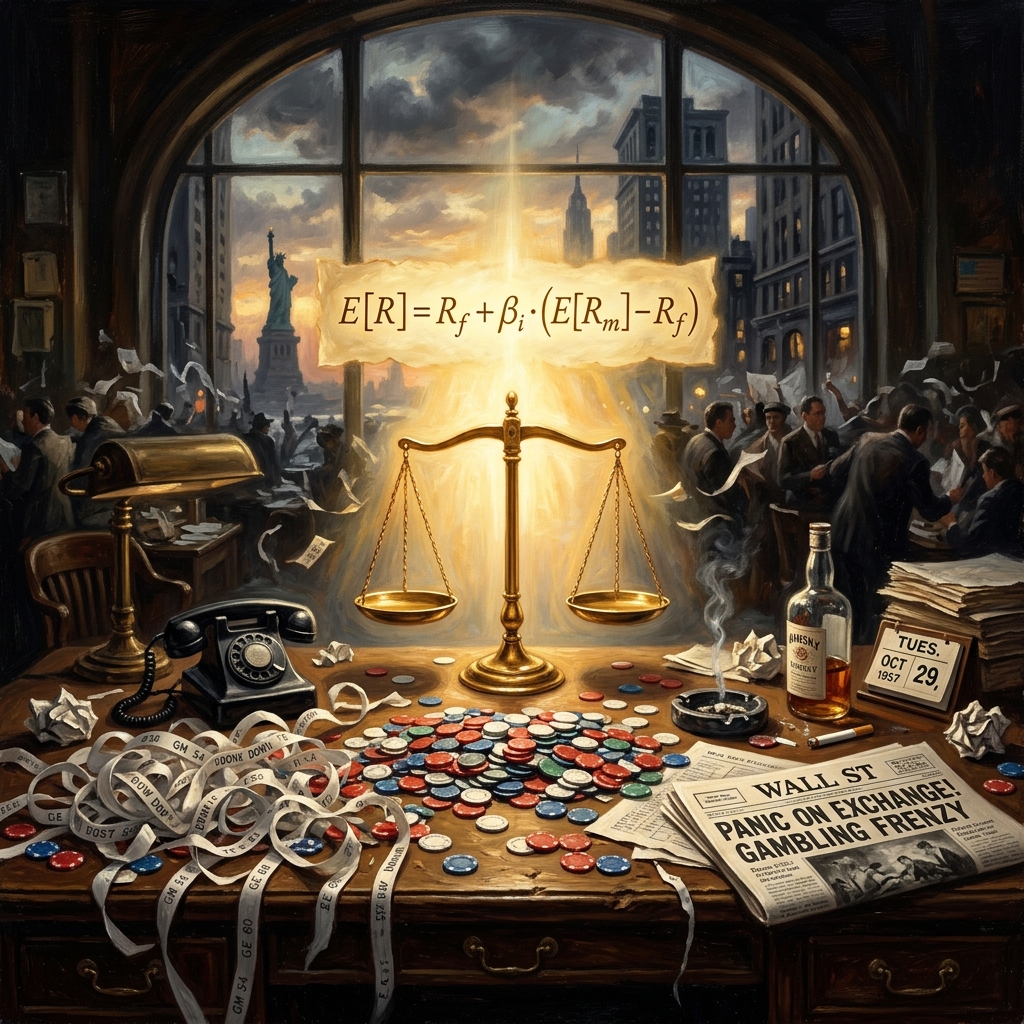
Arrogance and the Barbarism of Wall Street
When I first started investing in stocks, I was steeped in the arrogance that I could discover hidden ten-baggers by analyzing charts and chasing positive news. I mistakenly believed that investing was an art form, relying entirely on 'gut feeling' and 'intuition'.
However, looking back at history, this wasn't just my own delusion. Wall Street prior to the 1950s also treated investing as an 'art' and a 'gamble', much like many of us do today.
At that time, fund managers were obsessed with 'Stock Picking'—guessing which company would hit the jackpot that year. Rather than analyzing statistical risk, it was an era of barbarism where people believed that relying on rumors and intuition to "go all-in on the single stock with the highest expected return" was excellent investing.
Fortunately, two genius scholars arrived at this haphazard gambling den armed with mathematics and statistics, forever transforming the history of investing into a 'science'. They were Harry Markowitz and William F. Sharpe. Their research later became the philosophical root that made me abandon 'prediction' and buy the 'entire market'.
1. Harry Markowitz and Modern Portfolio Theory (MPT) 📖
In 1952, Harry Markowitz, who was only a 25-year-old graduate student, published a legendary paper titled "Portfolio Selection". He criticized human arrogance in trying to predict which stocks would rise tomorrow and introduced the concept of 'Risk (Volatility)' mathematically into the investment world for the very first time.
Explaining "Don't Put All Your Eggs in One Basket" with Mathematics
- Core Logic: Imagine Company A, which sells umbrellas when it rains, and Company B, which sells sunglasses when it's sunny. If we try to predict tomorrow's weather (the future), it becomes a gamble. But what if we own 50% of both Company A and Company B? Whether it rains or shines, we get a steady return every day.
- The Portfolio Effect: The moment you abandon prediction and mix assets with low correlation, the overall return remains intact, but the 'risk (volatility)'—the violent up-and-down swinging of your account—miraculously disappears.
Markowitz proved that when we thoroughly acknowledge the fact that "we cannot know the future (ignorance)", an efficient investment that minimizes risk becomes possible.
2. William Sharpe and the Capital Asset Pricing Model (CAPM) 📖
While Markowitz's diversification was a brilliant theory, calculating the correlations of hundreds of thousands of stocks individually was impossible with the technology of that time. That's when William Sharpe appeared and proposed a groundbreaking thought experiment to solve this complex problem at once.
"If all investors in the world were to diversify perfectly to eliminate risk as Markowitz suggested, where is the ultimate destination that people would end up owning?"
Sharpe's answer completely changed my view on investing later in life. "The ultimate destination is to own the entire stock market as a whole."
The Single Truth Diversification Cannot Erase: Beta (β)
Sharpe saw that while the bad news of individual companies (unsystematic risk) could be reduced to zero through diversification, the massive market risk of the entire economy collapsing (systematic risk) could never be avoided.
He named this unavoidable wave of the entire market 'Beta (β)'. He came to the profound conclusion that the reason we make money in stock investing is not because of our 'Alpha' skill in picking good stocks, but solely as the reward (risk premium) for silently bearing this terrifying 'Market Risk (Beta)' amidst fear.
3. The Sharpe Ratio: Shattering Human Delusion
Sharpe then devised the 'Sharpe Ratio' in 1966.
Sharpe Ratio = (Return of Portfolio - Risk-Free Rate) ÷ (Volatility of Portfolio)
It is an indicator that measures the 'cost-effectiveness' of an investment, dividing the return by the emotional distress (volatility) endured to achieve it. When the performance of Wall Street fund managers who boasted, "I made a 50% return," was plugged into this formula, the results were disastrous. Their seemingly spectacular returns were merely the result of gambling with massive risk, and in terms of cost-effectiveness, they couldn't even compare to a portfolio that simply parked money in the entire market (Beta).
The Need for a Practical Weapon
The history of these two genius scholars gave me a painful awakening only in the 2020s, after I had squandered the entire 2010s in blind investing and finally started studying again in 2021.
"Do not delude yourself that you can beat the market with your shallow skills. Abandon the arrogance of trying to predict the future; just buy the entire market (Beta) and defend your ignorance."
With this, the perfect academic framework for index investing (passive investing) was complete. However, for investors in the 1960s, this theory was just pie in the sky. It was realistically impossible for ordinary retail investors to buy and accumulate all the stocks in the market while paying exorbitant fees. The scholars had only provided a perfect blueprint; the 'weapon' that ordinary people could actually wield had not yet been invented.
The story of John Bogle, who brought this mere paper theory into reality and invented the first survival weapon (the Index Fund) that allowed ordinary investors like me to buy the market with a single click, will continue in the next chapter.
📚 [Evolution of Investment Series]
- Prologue: The Ultimate Survival Formula
- Chapter 1: The Great AwakeningCurrent
- Chapter 2: Birth of the Index Fund
- Chapter 3: Behavioral Finance
- Chapter 4: The 3-Factor Model
- Chapter 5: Birth of the ETF
- Chapter 6: Discovery of Momentum
- Chapter 7: Madness and Mentality (Smart Beta)
- Chapter 8: Birth of SCHD
- Chapter 9: Big Tech and SPMO
- Chapter 10: Evolution Continues
- Epilogue: Investing is a System