
Chapter 8. The Shield that Feeds on Fear: The Birth of SCHD

Primary sources and backtest limits
Index rules are checked against S&P Dow Jones Indices' Dow Jones U.S. Dividend 100 page and methodology; ETF information and risks are checked against the official Schwab SCHD page. Figures before SCHD's launch are hypothetical backtests, not live investment results. Dividend stocks can lag the market and dividends can be reduced.
Introduction: The Trauma of 2008, A Weapon Needed to Survive
The 'Global Financial Crisis' that erupted in 2008, right before I jumped into the stock market, was an apocalypse where the global capitalist system itself collapsed. If the 2000 Dot-com Bubble was the madness of some internet stocks, this time, massive banks that had been around for centuries went bankrupt overnight, and the S&P 500 shattered with a terrifying figure of -56%.
Reviewing the charts of this hellish past, I learned a bitter lesson. "If I encounter such a crash while investing in the future, will my mentality survive? To survive amidst the terror of stock prices plummeting vertically, I need something reliable that will make me forget the evaluation amount (numbers) in my account. I desperately need a sturdy shield that will never go bankrupt even in a crisis (Quality) and will constantly plug 'cash flow' into my pocket!"
1. Value Trap: The Terrible Ending of Blind Dividend Chasing
After the financial crisis, numerous investors turned their eyes to 'dividends', the most intuitive cash flow. "Even if the stock price halves, I can endure it if dividends keep rolling in regularly!"
However, blind high-dividend investing hid a terrible pitfall (Value Trap). When a company is going bankrupt and its stock price is slashed to 1/10, the nominal dividend yield skyrockets to an enormous 20%. Seduced by this fake number, investors bought the stock, only to face the disaster of the company cutting dividends and going bankrupt the next month.
What was needed was a ruthless system that would filter out not just garbage companies with high dividend yields, but only "truly high-quality companies (Quality) that earn money so crazily well that they wouldn't cut dividends even in a crisis."
2. 2011: Moving Beyond 'Blind Dividends' with a Rules-Based Index
Even before the 2008 financial crisis, dividend stock funds existed. However, most funds at that time were 'blind dividend indices' that uncritically swept up "stocks with simply the highest dividend yield (%)". Falling into the illusion (Value Trap) where the dividend yield of bank stocks plummeting on the brink of bankruptcy looked abnormally high, they eventually suffered a painful failure, crashing even more miserably than the market index during the 2008 crisis.
After suffering the trauma of this horrific financial crisis, the index provider (S&P Dow Jones) finally awakened. "If we just blindly chase dividends, we all die. A Quality filter that verifies the true strength (debt, cash flow) behind the dividends is absolutely necessary!"
Based on this bitter lesson, the 'Dow Jones U.S. Dividend 100 Index' was finally announced in August 2011, and the asset management company Charles Schwab surprisingly launched SCHD (Schwab US Dividend Equity ETF), which tracks this perfect index, in October of the same year. In 2011, when I was just starting to invest, the ultimate defensive weapon I would stay with for the rest of my life was introduced to the world.
People in the world often disparage or misunderstand SCHD as 'a retirement fund for old folks who want to buy soup with monthly dividends' or 'a fund expecting future dividend growth'. However, I want to completely shatter this shallow stereotype. The very expectation that 'dividends will continue to grow in the future' is nothing but a foolish prediction of the future. What if the company stops growing tomorrow?
Unlike the failed dividend funds of the past, the essence of SCHD is neither dividends nor dividend growth. Its true identity is a perfect 'Quality & Value ETF'. The concept of 'dividends' is merely used as a lagging and objective 'proof indicator' to judge whether the company is truly robust. SCHD does not predict the future; it is a quant machine that ruthlessly collects Fama-French's 'Value' factor and the money-raking 'Quality' factor solely through proven numbers.
The Harsh 4-Step Audition That Blocks Human Intervention
SCHD completely ignores the intuition of fund managers and extracts 100 champions solely based on numbers. Particularly, the lessons from the two horrific crises (Dot-com Bubble and Financial Crisis) discussed in Chapter 7 are perfectly and chillingly absorbed into these rules.
- [Pre-Filtering] Explicit Exclusion of REITs: Real Estate Investment Trusts, which were another epicenter of the 2008 subprime mortgage crisis, are completely blocked from entering the fund from the start.
- 10 Consecutive Years of Dividend Payments: This initially grinds away all the shell companies that only carried the ".com" name during the dot-com bubble, as well as the insolvent companies that cut dividends during the financial crisis. (Proof of extreme survivability)
- Free Cash Flow to Total Debt (Quality): This is the core filter that compensates for the blind spot of 'Value Investing' (financial/bank stocks) that collapsed during the 2008 financial crisis. Traditional banks like Lehman Brothers structurally use massive leverage (debt), making their debt ratios abnormally high. Through this metric, SCHD automatically filters out and executes these debt-ridden companies, even if their dividend yields or P/B ratios look high. It only leaves highly superior companies with cash bursting out of their pockets.
- Return on Equity (ROE, Quality Factor): The absolute indicator of the 'Quality Factor' for companies that make money incredibly well.
- Dividend Yield (Value Factor): Among the extremely few companies that pass the harsh survival audition of the above 3 steps, it finally sweeps up 100 companies whose stock prices have become cheap relative to their book value—that is, companies where the 'Value Factor' has emerged due to market fear at bargain prices.
3. The Titanium Shield That Protects My Mentality (Alpha Core)
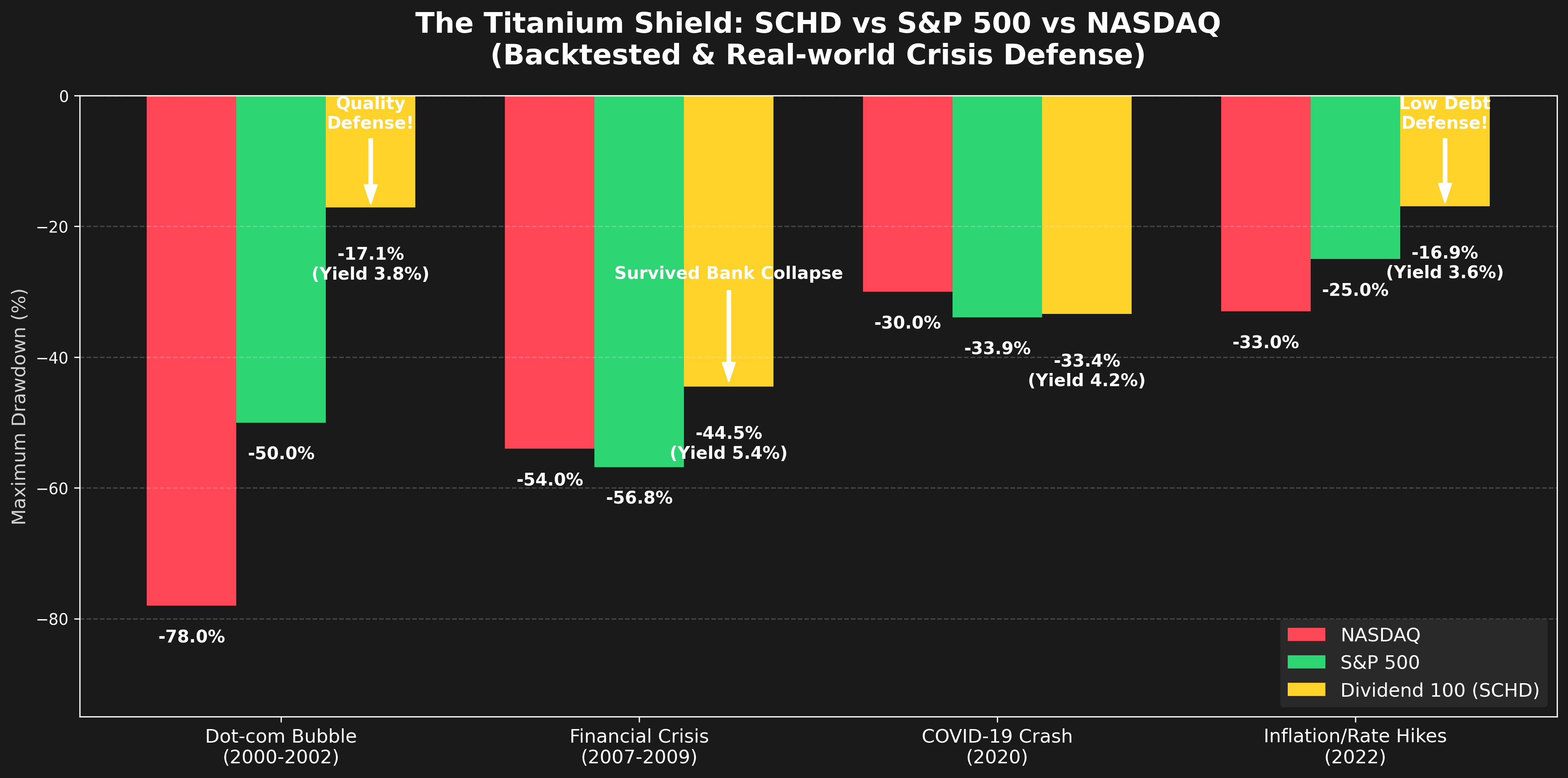 (Data: Maximum drawdown based on historical backtesting of the Dow Jones U.S. Dividend 100 Index and actual performance post-2011 launch)
Check out the insane defensive power this 4-step audition showed through actual historical data (backtesting).
- Dot-com Bubble (2000–2002): SCHD launched in 2011, so figures for this period are not live ETF returns; they come from applying the index rules to earlier data. In that material the simulated drawdown was smaller than those of the NASDAQ and S&P 500, but it does not guarantee live or future downside protection.
- 2008 Financial Crisis: When even value investing plummeted by -57% due to the bankruptcy of insolvent banks and the S&P 500 was smashed by -56.8%, SCHD, which automatically cut out rotting financial companies through the 'debt ratio' rule, avoided a fatal blow and defended at a relatively solid -44.5%. (Even in this period of terror, the dividend yield surged to 5.4%, and the massive cash flow deposited amidst the falling daggers prevented mental collapse.)
SCHD's behavior in two post-launch declines can be examined separately from the backtest. Two episodes, however, are not enough to conclude that the same defense will recur in every crisis.
- 2020 COVID-19 Pandemic: Even amidst the extreme fear of factories halting worldwide and stock prices plummeting vertically, SCHD's champions, who had proven their survival for over 10 years, unwaveringly delivered cash (dividends), holding the investors' mentality together so they wouldn't leave the market. (Note: The NASDAQ's smaller drawdown than value stocks or the S&P 500 during the COVID crash was related to the unusual environment of remote work and online consumption. The episode led me to examine growth and momentum exposure alongside value; it does not prove that a particular ETF must be held.)
- 2022 Inflation and Rate Hikes: When growth stocks and NASDAQ screamed with a -33% crash, the true power of the 'Quality' factor exploded. When interest rates rise, heavily indebted companies break first. However, SCHD companies, which inherently have low debt ratios and overflowing free cash flows in their pockets right now, were not hit by high interest rates. During this time, SCHD showed miraculous defensive power, essentially protecting the principal while the market was bleeding.
👉 Conclusion: SCHD is not a satellite branch taking up a corner of my portfolio. This weapon exploits the oversold gaps (Value) created by the public's irrational fear and prevents my mentality from collapsing through strong cash flows, making it the hardest and heaviest titanium shield (Alpha Core).
When the market is peacefully trending upwards, the index fund (Basecamp) reliably supports me, and when the economy collapses and screams erupt as if the world is ending, SCHD (Shield) protects me. All the lessons of history have been concentrated into this single ETF and placed in my hands.
Conclusion and Preview of Next Chapter: A Shield Alone Cannot Win
Index fund (Basecamp) and SCHD (Shield). A perfect defensive formation, akin to the textbook standard of investing, has been established. Armed with such perfect Quality and Value shield, one might think they could sleep soundly with both legs stretched out in real-world investing.
However, history presented another form of psychological hell to investors. Passing the 2022 bear market and entering 2023 and beyond, the market transformed not into a hell of 'fear', but of extreme 'greed'. An era of 'Winner-Takes-All' began, where a very few Big Tech companies, the so-called Magnificent 7 (M7), grabbed the entire US stock market by the collar and dragged it upward riding the AI revolution. The value defense that felt so reassuring until 2022 turned into a shackle of terrible FOMO (Fear Of Missing Out) from this point on.
During this period, the value investing (shield) that was believed to be perfect pushed countless investors into a maddening sense of alienation. Because the shield was so heavy and strict, it completely failed to keep up with the speed of the M7-driven market that was flying into space without paying dividends.
The bitter lesson that defense alone cannot control the greed of this crazy real-world market. Ultimately, perfect mental control becomes possible only by unsealing the most dangerous yet most powerful factor, Mark Carhart's 'Spear of Greed (Momentum)', which we learned about earlier in Chapter 6.
This extreme herd market post-2023 was the crucial period when I myself realized the limits of the shield (SCHD), felt the desperate need for an attacker (spear), and actively refined my own full-fledged 'Factor Core' investment philosophy.
The story of the final Alpha engine, SPMO, which will shatter the investor's sense of alienation amidst the monopoly of the M7, continues in [Chapter 9. The Sharpest Spear Controlling the Herd: SPMO].
📚 [Evolution of Investment Series]
- Prologue: The Ultimate Survival Formula
- Chapter 1: The Great Awakening
- Chapter 2: Birth of the Index Fund
- Chapter 3: Behavioral Finance
- Chapter 4: The 3-Factor Model
- Chapter 5: Birth of the ETF
- Chapter 6: Discovery of Momentum
- Chapter 7: Madness and Mentality (Smart Beta)
- Chapter 8: Birth of SCHDCurrent
- Chapter 9: Big Tech and SPMO
- Chapter 10: Evolution Continues
- Epilogue: Investing is a System