
Chapter 7. The Madness of Human Psychology and the Birth of Smart Beta

Introduction: The Bloody 2000s and the Questions Cast upon the Invincible Basecamp
The index fund popularized by John Bogle marked an important shift toward low-cost diversification. “Rather than trying to beat the market, own the market” became a central long-term principle in the Bogleheads community.
However, let us review history very coldly. Right in the middle of those hellish massive crashes of the 2000s, how many index investors actually succeeded in 'holding on' and surviving? To answer this question, we must dig into the cruel past to see how miserably human psychology can collapse, and how the emotionless index fund (the machine) drove our mentality to the edge of the cliff amidst this madness.
1. The Frenzy of Greed: The 2000 Dot-com Bubble and the Betrayal of the Machine
In the late 1990s, the world lost its mind and went crazy. Even if a company earned not a single penny and had a mountain of deficits, just appending '.com' to its name caused its stock price to skyrocket by dozens of times overnight. People quit their jobs to jump into day trading, sacrificing their souls to this greedy moth-to-a-flame party.
Amidst this terrifying madness, the 'first structural flaw' of the index fund we trusted so much opened its mouth like a demon.
- A Machine that Sweeps up Bubbles: An index fund has absolutely zero interest in whether a company actually makes a profit (fundamentals). It only follows the ignorant principle: "If the stock price (market cap) is expensive, buy more of it."
- As the public's madness shot the prices of internet garbage stocks to Andromeda, the index fund madly swept up this garbage at its absolute peak, abnormally inflating its weight within the S&P 500.
Passive investors who were sleeping soundly, thinking, "I didn't buy individual stocks, I bought the whole market, so I'm safe!" didn't realize that the machine (index fund) was committing the horrific act of intensively buying only the most bubbled stocks in the market with their own money.
Eventually, in March 2000, the party's music stopped, and the bubble burst.
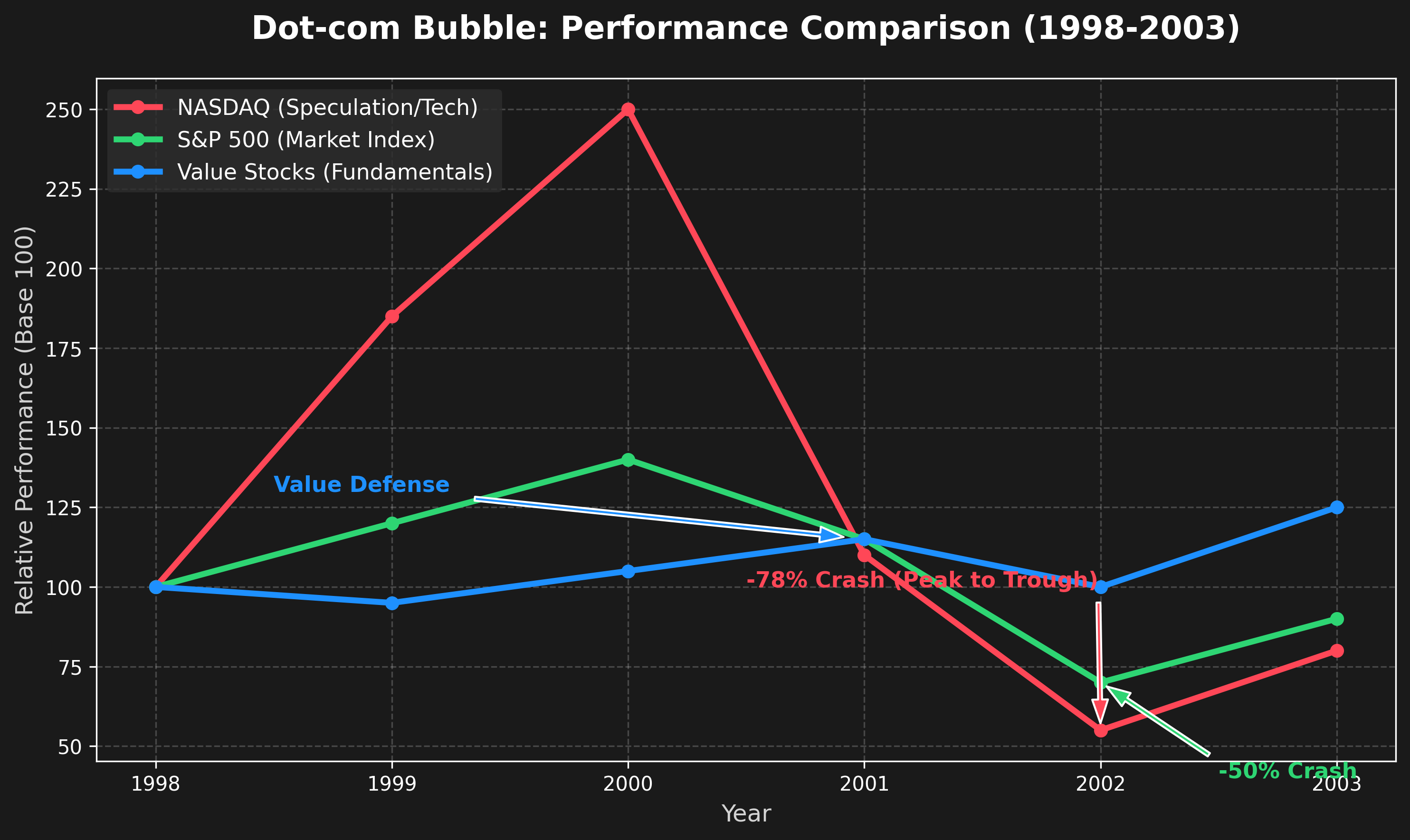
Many people guess, "Didn't the index fund at least defend well against the dot-com bubble compared to speculative hedge funds?" However, the history shown by actual data was brutal.
- Speculative NASDAQ (Hedge Funds/Growth Chasers): The seemingly endlessly rising NASDAQ plummeted by a staggering -78%, permanently bankrupting countless hedge funds that bet on skyrocketing stocks.
- S&P 500 (Market Index Fund): Was the index fund safe? No. Because of the market-cap weighted method, the S&P 500, which had aggressively stuffed over 30% of its portfolio with bubbling IT companies at the peak, also evaporated by -50%. The index fund was not a safe haven; it was severely contaminated by the bubble itself.
- Value Investing (Value Stocks): During the dot-com collapse, some value indices holding companies with earnings and cash flow fell less than highly valued technology stocks. Value stocks did not avoid losses altogether, however, and the result changes with the index and measurement period.
The index fund was never safe. It had to shed tears of blood, losing half its value as the price for uncritically collecting bubbled companies. The index fund we believed was a basecamp was actually a massive powder keg that had sucked up the bubble of greed to the very end.
2. The Apocalypse of Fear: The 2008 Global Financial Crisis and Rotting Pillars
It took a bloody 7 years to recover the principal of accounts halved by the Dot-com Bubble. In 2008, just as investors were barely catching their breath, the 'Global Financial Crisis (Subprime Mortgage Crisis)', an event that stopped the heart of capitalism, erupted.
If the Dot-com Bubble was a 'light madness' of newborn internet companies, the financial crisis was an apocalypse itself, where century-old giant banks and financial institutions went bankrupt overnight. And within this hell, the 'second fatal flaw' of the index fund exploded.
- Blindly Embracing Insolvency to the End: The market index had included traditional giant financial institutions that had grown their size over a long period at a massive weight. The problem was that the insides of these giant pillars were completely rotting away with toxic subprime mortgage debt.
- Even if a company's books are rotting and it is driven to the brink of bankruptcy, the index fund continues to embrace the company within the index until it is completely delisted and its stock price hits '$0', plummeting together.
The S&P 500 embraced the rotting giant financial institutions to the very end.
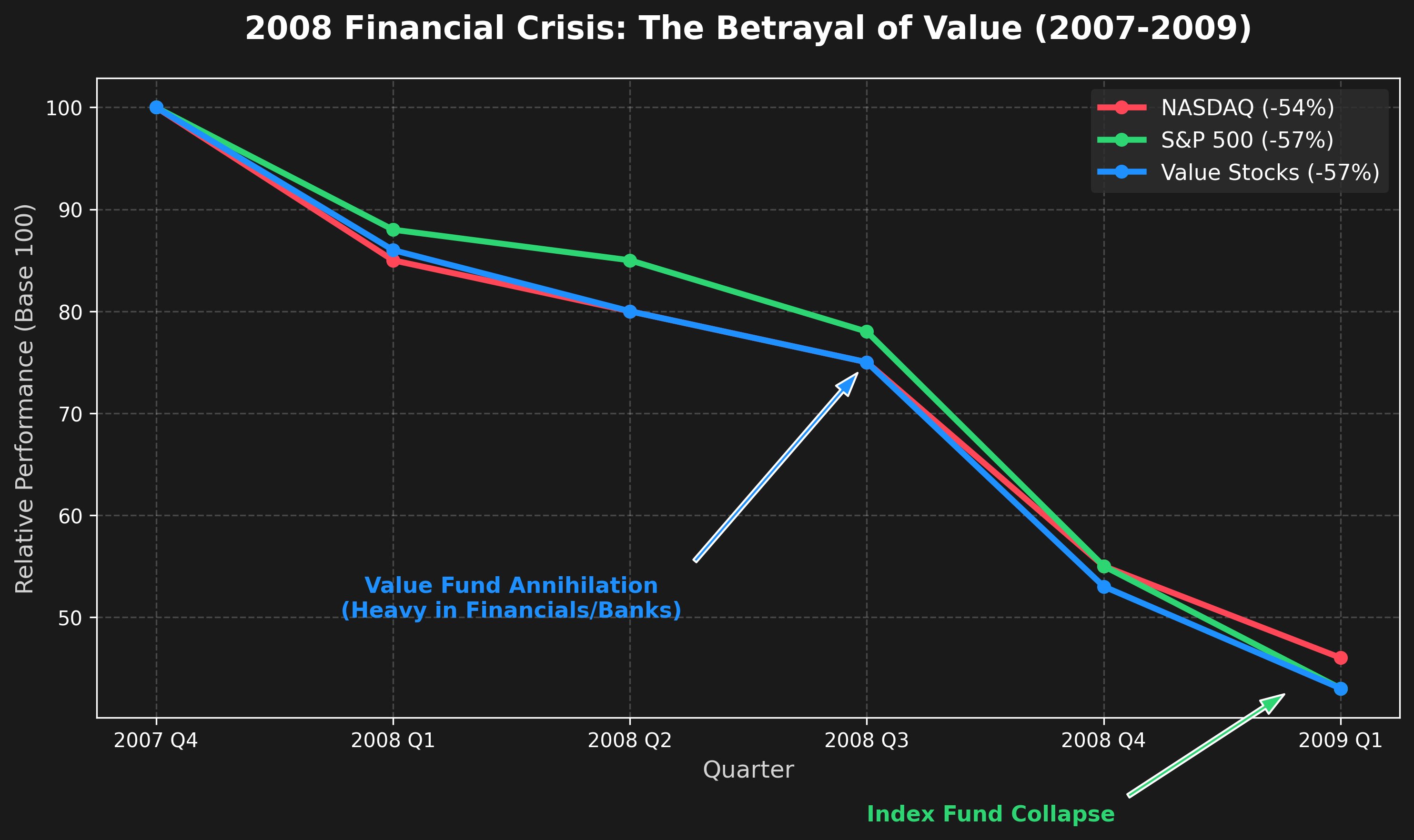
The despair shown by the data during this period was entirely different from the dot-com bubble.
- S&P 500 (Market Index Fund): The S&P 500, holding massive insolvent banks (like Lehman Brothers) simply because of their large sizes, once again experienced a horrific plunge of -56.8%.
- Speculative NASDAQ: The tech-heavy NASDAQ also plummeted by about -54% due to the overall market panic.
- Value Investing (The Betrayal of Value Stocks): Here comes the most shocking plot twist. What happened to the Value Funds (based on Russell 1000 Value) that had won the dot-com bubble and were revered as the ultimate shield? By the nature of value investing, the sectors with the lowest Price-to-Book (P/B) ratios were 'Financials/Banks'. As a result, value funds were holding the most insolvent banks right before their bankruptcy, and taking a direct hit from the subprime mortgage crisis, they recorded a -57.0% plunge, which was even worse than the broader market index. (Data Reference: Russell 1000 Value Index Peak-to-Trough, 2007.10~2009.03)
The 'Value Investing' that was the perfect shield during the dot-com bubble became a rotten shield that shattered first in 2008. Within a mere 10 years, investors had suffered the horrific crash of their entire net worth being halved twice.
3. Survivors Forged by the Dot-com Bubble and Financial Crisis: The History and Limits of Bogleheads
In fact, the iron-clad philosophy of the 'Bogleheads'—"No matter what crash comes, hold the index fund and endure to the end"—was not perfected by armchair scholars from the beginning.
💡 Reference: The History of Bogleheads and 'Stay the Course'
Their roots began in March 1998 as a small group ('Vanguard Diehards') on the Morningstar forum. They were immediately subjected to the first living hell of the 2000 Dot-com Bubble's madness and crash, testing John Bogle's teachings in real combat. The survivors who endured the bubble's collapse wanted to escape the commercialism of the financial industry. Thus, in February 2007, they finally launched the independent 'Bogleheads.org' website, officially compiling their own philosophy.
As if by a twist of fate, right after launching the site, the 2008 Global Financial Crisis arrived. Amidst the terror that capitalism was doomed, their accounts were halved once again. However, they gathered on their website, shouting "Stay the course!" to encourage each other and hold onto their mentalities. Through this bloody, tight-knit epic of survival, the community achieved explosive global growth.
However, separate from the beautiful solidarity of the Boglehead community comforting each other... demanding an ordinary individual who is not a robot to "blindly 'Stay the Course' holding only the market index and endure getting halved twice" is close to psychopathic violence beyond cruelty. When the news screams every day that banks are going bankrupt and you watch your retirement funds melt away, almost no human can maintain their reason. In reality, countless ordinary investors eventually threw away their index funds in terror at the bottom and were permanently expelled from the market. I needed something that would redefine this harsh slogan into maintaining my own Course that I can mentally endure to the very end.
Atop this gruesome mountain of corpses, cold-headed investors gained another bitter realization. "Index funds remain an important core. To help me follow the plan through severe declines, however, assets with different index rules may serve as a useful complement." This is a behavioral design choice, not a claim that losses will be prevented.
The answer that emerged to this was 'Smart Beta', created by Rob Arnott and others in the mid-2000s. These are revolutionary funds that completely ignore 'stock prices (market cap)' tainted with human madness, and solely determine weights based on real numbers recorded in accounting books—namely, fundamentals like revenue, book value, earnings, and dividends.
Smart Beta is not a single replacement for a broad market index; it is a way to target selected rules such as value or profitability. Such rules may reduce exposure to some expensive or financially weak companies, but they cannot be expected to avoid a new crisis or outperform the market.
Conclusion and Next Chapter Preview: A Complement for Staying Invested
An investor's most terrifying enemy is not a market crash, but 'their own mentality' that gets sick of the crash and leaves the market voluntarily.
Smart Beta technology does not simply look for large companies, but searches for Quality that remains unshakeable in any crisis, and Value that can plug warm cash flow (dividends) into my account every month while I shiver looking at my halved account.
Building on those experiences and reflections on investor psychology, the next chapter examines the index rules and risk-return characteristics of SCHD, launched in 2011, and why I assigned it a defensive role in my portfolio: [Chapter 8. The Shield that Feeds on Fear: The Birth of SCHD].
📚 [Evolution of Investment Series]
- Prologue: The Ultimate Survival Formula
- Chapter 1: The Great Awakening
- Chapter 2: Birth of the Index Fund
- Chapter 3: Behavioral Finance
- Chapter 4: The 3-Factor Model
- Chapter 5: Birth of the ETF
- Chapter 6: Discovery of Momentum
- Chapter 7: Madness and Mentality (Smart Beta)Current
- Chapter 8: Birth of SCHD
- Chapter 9: Big Tech and SPMO
- Chapter 10: Evolution Continues
- Epilogue: Investing is a System