
[Chapter 2] The Heretic of Wall Street: The First Weapon to Defend My Ignorance, the Index Fund
Source and interpretive scope
Comparisons between active funds and benchmarks are checked against S&P Dow Jones Indices' SPIVA overview and methodology. Results vary by country, asset class, and period, and some active funds outperform. This is my narrative of index-fund history, not a recommendation that every investor use the same product.
The Theory Was Refined, But the Public Had No Practical Tool
As discussed in the previous chapter, the work of Harry Markowitz and William Sharpe provided a theoretical foundation for diversification and market risk. That research also informed my decision to adopt market index funds in 2022 after years of trial and error.
However, ordinary retail investors in the 1960s couldn't use this truth even if they knew it. Mentally, they understood "buy the whole of America," but in the reality of Wall Street, the 'weapon' (financial product) that could encapsulate the 'entirety of America' simply did not exist.
1. Pie in the Sky, and Murderous Fees
Even back then, the benchmark indicator called the 'S&P 500 Index' clearly existed. If you turned on the news, they would show the numbers, saying, "Here is today's stock market." However, actually replicating this index in an ordinary person's account was a completely different level of hell.
For an individual to track the S&P 500, they had to directly buy all 500 companies' stocks according to their proportions.
- It required an enormous amount of capital that was impossible to attempt unless you were quite wealthy.
- Moreover, the broker's murderous trading fees incurred from adjusting (rebalancing) the weight of 500 stocks daily according to price fluctuations would tear apart the principal painfully.
In the end, abandoning prediction and riding the market return (Beta) was a privilege reserved only for massive pension funds and institutional investors. It was a bleak era where the general public was still being ripped off by expensive fees and forced to entrust their retirement to the gambling dens of greedy fund managers.
2. The Appearance of a Savior: John Bogle and the Birth of the First Weapon
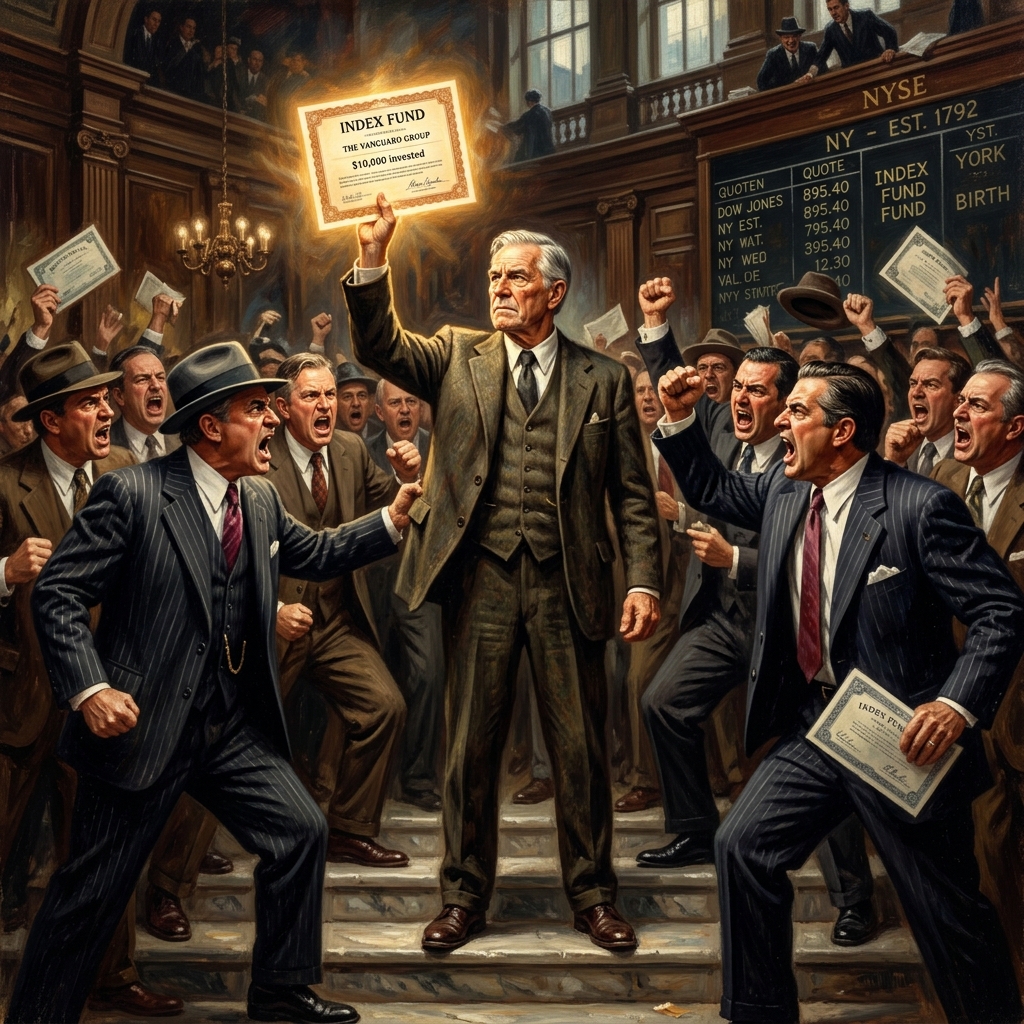
During this time, a great heretic appeared on Wall Street to save retail investors. His name was John Bogle.
He despised the existing fund industry, which was stained with fund managers' bonus parties and fee gouging. "Stop emptying the customers' pockets to fatten the company!" In 1974, he founded the 'Vanguard Group', an asset management company with a unique structure where the fund subscribers (shareholders) became the owners of the company.
And on August 31, 1976, he introduced to the world the greatest invention in human financial history and the first defensive weapon handed to retail investors: the 'First Index Investment Trust'. This is the predecessor of the 'Vanguard 500 Index Fund', which would later become the market index fund that I love so much.
💡 Note: Market Index Fund vs VTI vs S&P 500 (VOO, SPY)
The fund that pursues the 'true entire market' as advocated by John Bogle is VTI (Vanguard Total Stock Market ETF), which includes all ~4,000 companies (large/mid/small cap) listed on the US stock market. However, the S&P 500 index (Representative ETFs: VOO, SPY, IVV), which gathers only the top 500 large-cap companies, also accounts for over 80% of the total US market capitalization and practically represents the flow of the entire market. Therefore, in modern investing, both indices are used interchangeably as synonyms for an excellent 'Market Index Fund'. Unless specified otherwise in this series, 'Index Fund' or 'Market Index' encompasses the concept of both the S&P 500 and the entire US market (VTI).
The Principle of the Weapon That Changed the World
John Bogle's idea was simple yet revolutionary. "Our Vanguard will use massive capital to buy all 500 stocks as a whole and put them in one big basket. Then, let's slice the 'shares' of that basket very thinly and sell them to ordinary workers. Fund manager salaries? We don't need that crap, so we'll only charge a cost close to free!"
The moment this weapon was placed in the hands of the public, a miracle occurred where even an individual with just a few dozen dollars could escape the tricks of fund managers and perfectly enjoy the growth of capitalism as a whole (Beta).
3. "Bogle's Folly" and a Great Victory
However, the initial launch of this great shield was humiliating. The greedy fund managers and brokers of Wall Street poured immense criticism and mockery on John Bogle. It was because a demon had appeared that would smash their rice bowls (fees).
- "What idiot in the world would entrust their money to just get the 'Average' instead of being number 1?"
- "To give up the human will to beat the market, this is an Un-American and communist idea!"
Wall Street ridiculed the fund as 'Bogle's Folly.' Later scorecards have shown that many active funds underperformed their benchmarks after fees over long periods. The percentage varies by market, time window, and treatment of survivorship bias, so no single figure is a universal law.
Broad Diversification, Yet a Remaining Weakness
Today, thanks to John Bogle, I was able to easily acquire the perfect basecamp called the S&P 500 (Market Index) and begin investing. The Efficient Market Hypothesis (EMH) 📖, which states "The market is perfectly rational, so just hold an index fund and sit still," became the faith of numerous Bogleheads for a long time.
However, the deeper I dug into history, the more I realized that this seemingly perfect weapon alone could not fully protect our mental state in real-world investing.
Monday, October 19, 1987. On a perfectly ordinary morning without any bad economic news, the Dow Jones index plummeted by a staggering 22.6% in a single day—an unprecedented massacre known as 'Black Monday'. It was an event that historically exposed that the stock market, which was thought to be as rational as a computer, was actually an 'irrational mob' that would jump off a cliff like crazy at the slightest noise.
Humans, and the market, are never rational. How scholars studying the madness of this disastrous Black Monday created a new weapon called the Value Factor that counter-exploits human irrationality (fear) will unfold in the next chapter.
📚 [Evolution of Investment Series]
- Prologue: The Ultimate Survival Formula
- Chapter 1: The Great Awakening
- Chapter 2: Birth of the Index FundCurrent
- Chapter 3: Behavioral Finance
- Chapter 4: The 3-Factor Model
- Chapter 5: Birth of the ETF
- Chapter 6: Discovery of Momentum
- Chapter 7: Madness and Mentality (Smart Beta)
- Chapter 8: Birth of SCHD
- Chapter 9: Big Tech and SPMO
- Chapter 10: Evolution Continues
- Epilogue: Investing is a System