
[Chapter 3] Humans are Not Rational: Black Monday and Behavioral Finance
The Past Religion of the Efficient Market Hypothesis (EMH)
In the late 1960s, University of Chicago scholar Eugene Fama, later a Nobel laureate in economics, studied how information is reflected in stock prices. The efficient-market hypothesis and random-walk literature offered evidence that earning persistent excess returns from past prices alone is difficult; they did not prove that every form of predictability is impossible.
Taking this one step further, he built a massive theoretical temple called the 'Efficient Market Hypothesis (EMH) 📖'.
"The market is a perfect supercomputer where countless smart investors process information at the speed of light. Whenever good or bad news about a company emerges, the stock price instantly and accurately finds its fair value. Stock prices are always perfectly rational, and there is no free lunch in the market. So don't try to predict the market with your shallow skills; just hold the entire market (Index)."
In the 1970s and 80s, when John Bogle's index funds were becoming popular, mainstream economics and Bogleheads worshipped Eugene Fama's hypothesis as an absolute religion, praising the justification of passive investing. When I first learned about investing, I too was completely fascinated by this logic. "Right, the market is smart, so I just need to buy the market average (Beta) and take a sleeping pill."
But if you look a little deeper into history, you can see how brutally this firm belief in a 'perfect and rational computer' was shattered in the bloody, real-world stock market.
1. October 19, 1987: The Religion Collapses (Black Monday)
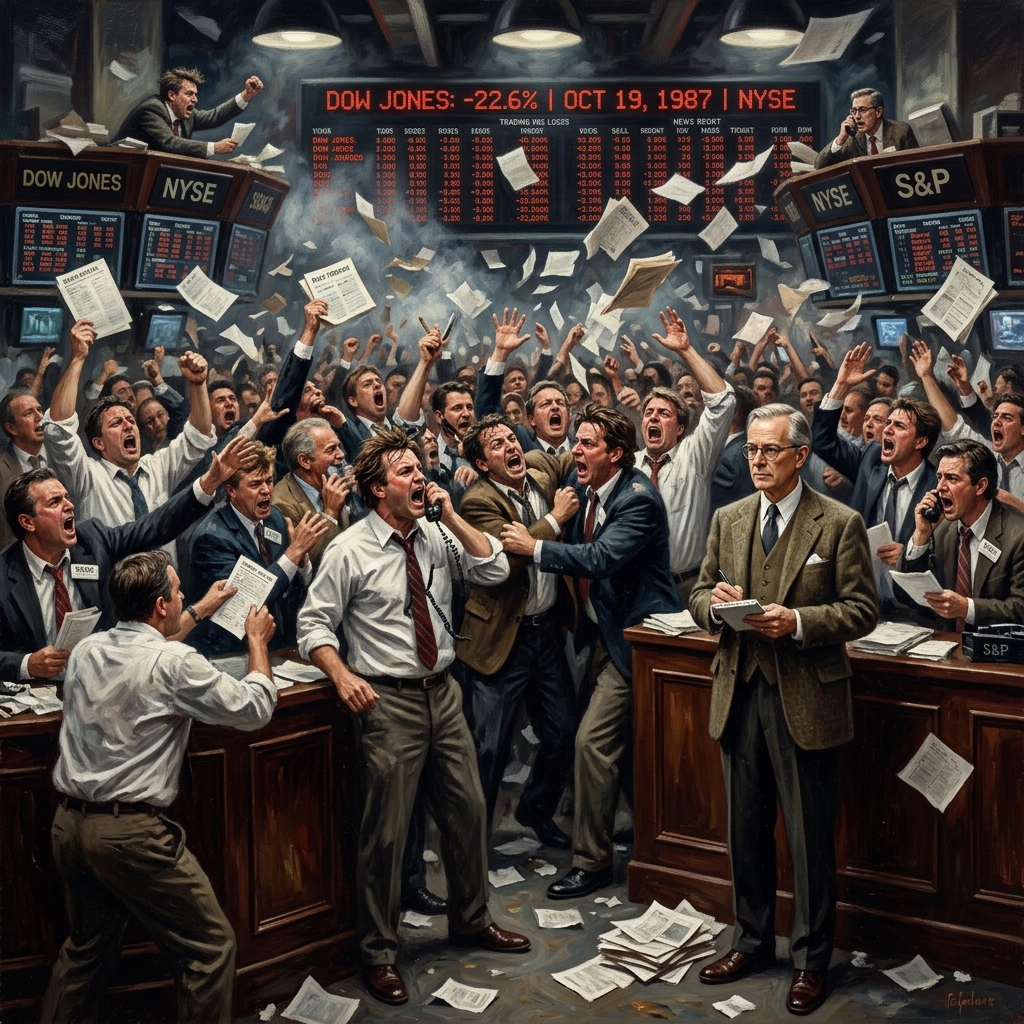
Investing does not operate solely on textbook math. The most terrifying proof of this is the disaster that occurred on Monday, October 19, 1987. It was an extremely peaceful day fundamentally, with no pandemics or wars.
However, right after the opening bell, someone started dumping stocks for no reason, and people in the market lost their minds and frantically mashed the sell button like zombies. As a result, an unprecedented massacre occurred where the Dow Jones index plummeted a whopping -22.6% in a single day. This is the famous 'Black Monday'.
If the market were a perfect computer, there would be no reason for the entire value of American companies to evaporate by 22% in just one day. The scholars' advice to "stay rationally still" offered no comfort to the crowds facing the terror of their accounts being halved. If I had been holding only an index fund in that era, would my mentality have survived? My shield would likely have been thrown away in panic that day.
2. Psychology Stabs Economics: The Rebellion of Behavioral Finance
When economists became mute in the face of this bloody crash, heretics appeared who applied the yardstick of psychology to the world of investing. They were Daniel Kahneman and Richard Thaler.
They accurately saw through not only the investors of that time but also the nature deeply hidden in my own heart, as I had been swayed by greed and fear for 11 years throughout the 2010s. "Since when have humans been as rational as calculators? The stock market is not a computer, but a herd of monkeys running wild with greed and fear!" This was the birth of Behavioral Finance.
The Psychological Reasons That Ruin Our Investments
Investors in history and I share the exact same weaknesses.
- Loss Aversion: Humans feel more than twice the pain when losing $1,000 compared to the joy of earning $1,000. So, when stock prices drop even slightly, regardless of fundamentals, we lose our reason and dump stocks at a bargain. Especially with 'Size' (small-cap stocks) where the fear of bankruptcy looms larger, the public exhibits the cruel habit of dumping them first and at the lowest prices.
- Herding: If everyone else is selling, we throw ours away too, terrified of being left alone on the cliff. Conversely, during the Big Tech rally of the 2020s, when others became overnight millionaires, we fell into FOMO (Fear Of Missing Out) and eagerly bit into stocks at their expensive peaks.
3. The Blind Spot of Bogleheads and the Need for a New Weapon
When behavioral finance emerged, active managers cheered. "See! The market is stupid, so if we time it right, we can beat index funds!"
But the real conclusion was the exact opposite. If the market goes crazy and no one knows the timing of a crash, there was no way managers could avoid that panic either. However, just stopping at being a simple Boglehead (blind faith in indices) is also dangerous. Holding only a market index during a crash (like Black Monday) or an extreme momentum market and enduring it by chanting "the market is always right" is immense torture for emotional humans.
At this point, I realized: We shouldn't force ourselves to suppress human irrationality (fear and greed). Instead, we desperately need a 'complementary weapon' that can reverse-engineer and exploit those irrational stampedes.
Conclusion & Next Chapter Preview: Breadcrumbs Left by Fear
The history of Black Monday and behavioral finance gave me crucial insights. When the public runs wild with fear, 'irrational gaps' appear all over the market. This is the oversold phenomenon where people, too terrified by bad news, dump stocks much cheaper than their fair value.
In fact, long before academia researched this, there were people who built legendary wealth by exploiting this irrational fear in practice. They are Warren Buffett and Charlie Munger. Ignoring the scholars who claimed the market was perfect, they never wavered even amidst the bloody crash of Black Monday in 1987. Instead, they scooped up excellent companies (like Coca-Cola) dumped by the terrified public at bargain prices, proving the greatness of Value investing with their actual performance.
However, their approach seemed like an art form available only to a few investors with unusual intuition and insight. In 1992, Eugene Fama and Kenneth French documented systematic historical return differences between value and growth stocks and proposed a factor model to explain them. This was not a mathematical guarantee of future value-investing returns, but an effort to explain an observed historical premium.
The story of the great academic counterattack, which forms the backbone of the second weapon that will later become the shield of my portfolio (SCHD), continues in the next chapter, Chapter 4. Exploiting Fear: The Proof of the Value Factor.
📚 [Evolution of Investment Series]
- Prologue: The Ultimate Survival Formula
- Chapter 1: The Great Awakening
- Chapter 2: Birth of the Index Fund
- Chapter 3: Behavioral FinanceCurrent
- Chapter 4: The 3-Factor Model
- Chapter 5: Birth of the ETF
- Chapter 6: Discovery of Momentum
- Chapter 7: Madness and Mentality (Smart Beta)
- Chapter 8: Birth of SCHD
- Chapter 9: Big Tech and SPMO
- Chapter 10: Evolution Continues
- Epilogue: Investing is a System